In every school’s fundraising meeting, it is likely a question that will be asked at some point or another: “Do our donors feel appreciated?” This is a very simple and yet important question. After all, you can’t be ungrateful, gratefulness is one of the strongest forces for repeat giving.
Donor behavior studies have consistently revealed that once people feel seen, valued and connected to the cause they’ve donated to, they come back. For schools and educational institutions, donor recognition technology is making a serious impact, making the connection year after year, quietly.
The Gap Between Giving and Feeling Recognized
The traditional methods of donor recognition have been the physical plaques, named rooms, or print in programs in the middle of event brochures. While they are not meaningless gestures, they do have definite limitations:
- The bronze plaque hangs in a hallway and no one pays attention to it.
- A name in a program gets reused.
- If the physical display becomes outdated or falls into disrepair, the recognition starts to feel more like an oversight than an honor.
The impact is lost when a donor’s name is taken off a faded plaque or when their name is added to a long list of hundreds of other donors on a crowded wall. Along with that, too often,the motivation to give again goes away..
It’s that gap that’s supposed to be bridged by the technology of recognition, not by replacing the spirit of recognition, but by making it more personal, more visible, and more lasting
Why Recognition is Effective in Increasing Repeat Giving
Recall the last time you were sincerely thanked for something. You probably remembered it and it made you want to do that thing again. Donors aren’t any different.
Research in philanthropy and behavioral psychology shows that donors who feel valued are much more likely to make repeated contributions, and more likely to give larger gifts. The answer is simple:
- Validation: When others acknowledge the contributions, it validates the decision to give.
- Identity: It helps reinforce the donor’s identity as supporting something important. It’s not just a transaction, it’s a relationship.
- Social Proof: They’re fascinated by the possibility of their own legacy when they see their peers displayed on an interactive screen. When people see others’ stories of the importance of giving, they are more likely to envision themselves being part of that story.
Here’s What Digital Donor Recognition Really Looks like
Today, donor recognition technology is more than just a list of names scrolling across a screen. School platforms can feature:
- Giving histories
- Named scholarships
- Impact of Stories
- Campaign milestones
At best, digital donor recognition isn’t just a database, it’s a living tribute. A donor’s story could be about the scholarship they helped launch, the students who were helped, the program they helped create, and all woven together in a way that communicates genuine impact rather than just a dollar amount.
This is the type of narration that is important. It transforms a donation from a line item into a legacy, something the Donor can look back at and say “I helped build that.”
From Hallway to Anywhere: The Power of Accessibility
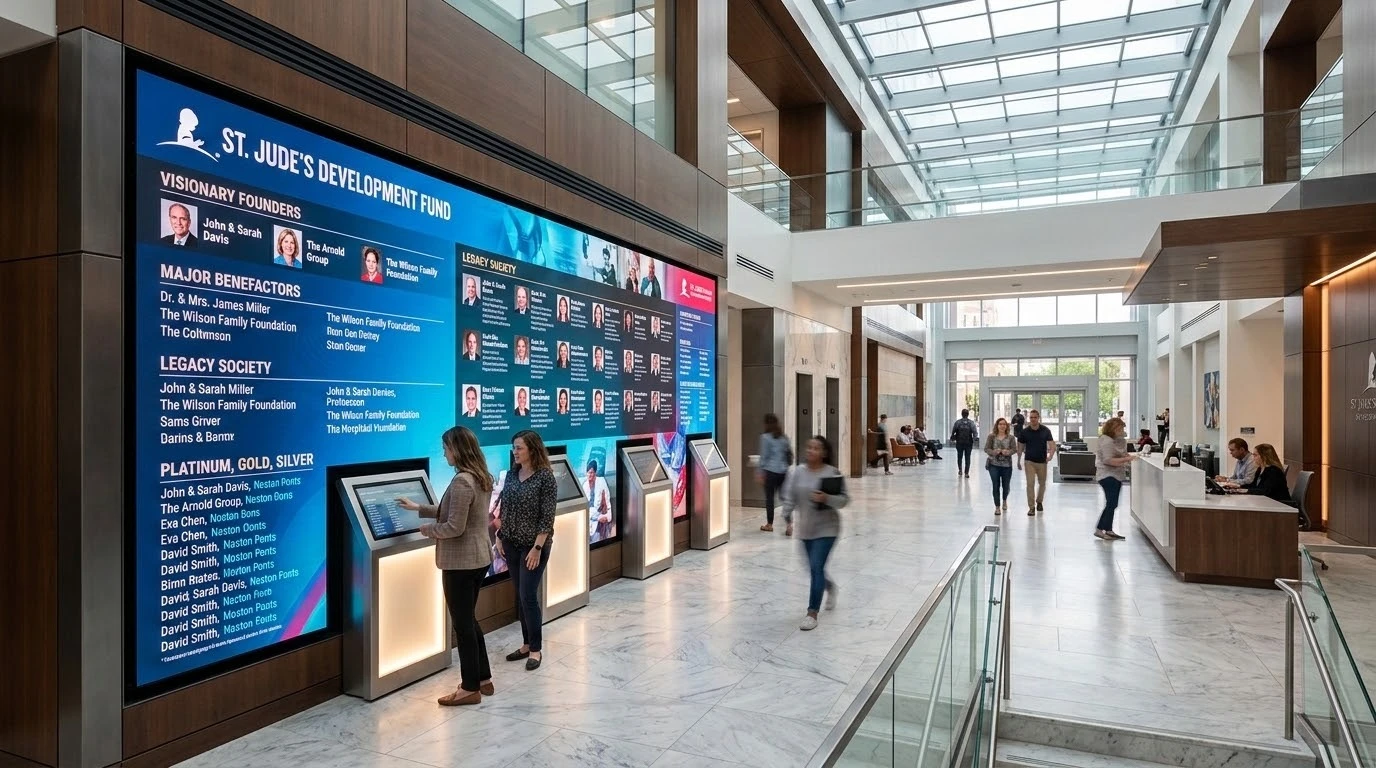
Accessibility is one of the least talked about benefits of the recognition platforms of the modern era. What can be seen on a physical display is only for those who walk by. However, a cloud-based system can be accessed by:
- Alumni in another country
- Parents at home
- Prospective donors that have yet to step onto the campus
Digital donor walls take recognition beyond the physical constraints of a building. It is so much more effective than a plaque on a wall that, when a donor has the ability to get their recognition page on their phone across the globe, it helps to cement the emotional bond to the institution. That ease of access also makes sharing much simpler. A proud donor may share their honor with family members or friends, thus extending your school’s fundraising reach.
Maintaining Recognition Without the Headache
A practical problem with traditional donor recognition is the maintenance. It takes time and money to engrave a new name on a wall. Additions of Scholarship to a printed program are only made possible at the next publication cycle. Meanwhile, newer donors may not be acknowledged for months, a gap that can quietly erode goodwill.
This is addressed by digital platforms that use content management systems to enable schools to update their donor recognition in real-time:
- A new gift can be acknowledged in the same week that it is received.
- Campaigns can be used to visualize progress towards goals.
- The scholarship recipients may be added, as soon as they are selected..
All of this is done with no design team or technical skills, just a few clicks. That instant gratification is telling you “Your gift mattered and we want you to know it right now.”
The Long Game: Building a Culture of Giving
Maybe the best reason to invest in recognition technology is not even about individual donors, but institutional culture. Schools that display and recognize their donors build a culture of giving in the school.
- Students: As students see the importance of alumni generosity, current students learn that it is part of being a member of this community.
- Parents: The social norm develops when parents see others being rewarded for their involvement.
- Prospective Families: When prospective families visit a school they see a dynamic, interactive, donor impact presentation, it signals that the school cares a lot about its community.
These signals build up over time. A school that puts the effort into effective recognition is not only keeping current donors, it is raising up the next generation of donors.
The Bottom Line
Will donor recognition technology enhance donations in the future? Yes, the research and practice suggests so. It is important, however, to be clear why. It’s not because flashy screens are more impressive than plaques. Because if you do a good job at recognition, in whatever form, donors feel valued. Technology simply helps make that recognition better , more consistent, more personal and more accessible than ever.
Implementing the right recognition platform is no longer a luxury, it’s a strategy for schools that want to foster a culture of giving. Donors who feel good about providing a gift are not only repeat donors, but they feel good about what they did. They give more, they tell others and they become ambassadors for your mission. That’s a return on investment that’s far greater than a mere donation.
