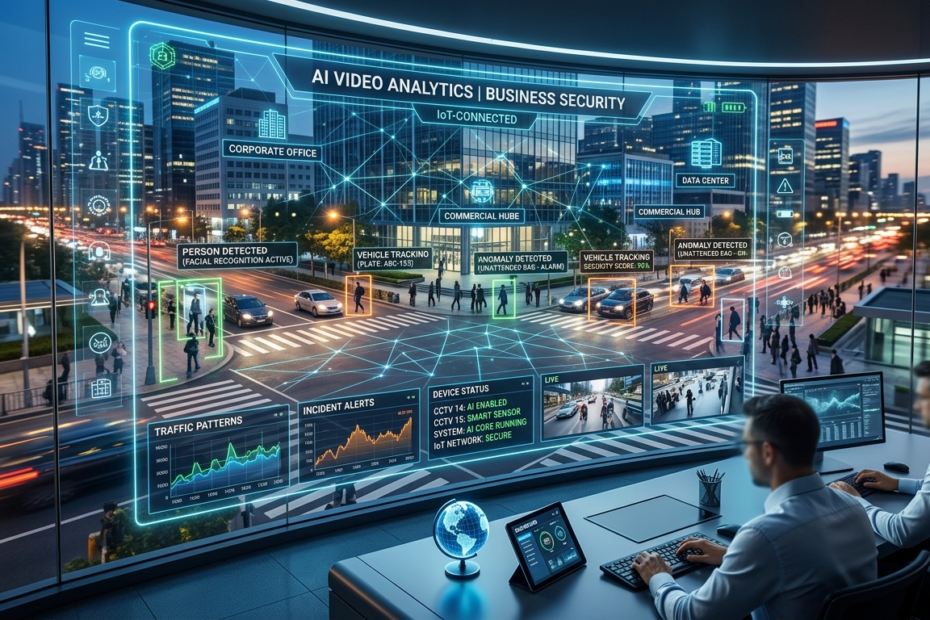
Businesses today operate in an interconnected digital landscape. While cybersecurity and data privacy often take centre stage in corporate strategy discussions, physical security has quietly undergone a massive technological evolution. By shifting away from purely reactive methods, organisations can dramatically improve their overall incident response times.
Modern surveillance systems no longer merely record grainy video to be reviewed manually days after an incident. Instead, the rapid convergence of the Internet of Things (IoT) and artificial intelligence has transformed physical security into a highly proactive, data-driven ecosystem. This shift enables facility managers to anticipate risks before they escalate, optimise daily operations, and protect assets with unprecedented precision.
Before these advanced systems can function at peak capacity, businesses must ensure their baseline infrastructure is flawlessly executed. Deploying smart cameras requires precise setup from experienced CCTV installers Melbourne to guarantee accurate data capture for machine learning algorithms.
The Evolution from Passive Surveillance to Active Intelligence
For decades, commercial security relied heavily on static, reactive measures. Security guards monitored massive walls of screens, checking video archives only when something went wrong. Today, analogue cameras are being replaced by smart IoT nodes capable of processing visual data in real time.
These advanced networks use edge computing to analyse video feeds directly at the source, drastically reducing network latency and allowing for immediate threat detection. The visual data feeds directly into enterprise software systems. This integration perfectly illustrates how AI and data analytics are reshaping business decisions, empowering teams to identify bottlenecks, monitor foot traffic, and streamline complex workflows based on actionable intelligence rather than guesswork.
Establishing the Right Hardware Infrastructure
Upgrading to an AI-driven framework is not as simple as purchasing a software licence. The physical foundation must be flawlessly designed to support high-bandwidth transmission and continuous machine learning processing. If a camera is positioned poorly or a connection is unstable, algorithms simply cannot receive the clear visual input needed to function.
Professional configuration guarantees that dangerous blind spots are eliminated, complex lighting variations are properly accounted for, and network lag is completely minimised. Modern installations utilise Power over Ethernet (PoE) technology and encrypted IP networks, ensuring hardware is reliable and secure against cyber threats. Without this expert baseline installation, the entire predictive security model could fall apart under pressure.
The Tangible Impact of Machine Learning on Operations
The true power of modern video analytics lies in its ability to operate continuously. Human operators naturally lose focus over long shifts, easily missing subtle anomalies. Artificial intelligence solves this problem by maintaining constant vigilance twenty-four hours a day.
According to a detailed insight report by TechUK, the core strength of this technology is its ability to efficiently comb through massive amounts of visual data to identify hidden trends and anomalies.
When implemented correctly, AI video analytics provide several transformative benefits:
- Automated Threat Detection: Algorithms can distinguish between swaying trees and an unauthorised person, drastically reducing false alarms. This ensures that security personnel only respond to genuine, verified threats.
- Predictive Maintenance: IoT sensors combined with visual data can monitor equipment, alerting managers to potential mechanical failures before they cause operational downtime.
- Space Utilisation Tracking: In corporate environments, video analytics map high-traffic zones. Businesses use this data to optimise office layouts or improve customer flow.
A New Era for Corporate Security
The integration of IoT devices and AI has redefined physical security. What was once viewed purely as a defensive cost centre is now a vital component of a company’s corporate data strategy. Facility managers and IT directors are collaborating to maximise the value of connected surveillance networks.
By investing in smart video analytics and ensuring robust infrastructure, business leaders unlock operational insights while maintaining a secure environment. As technology advances, the line between security hardware and business intelligence software will only blur further, making these integrated networks an essential asset for any forward-thinking organisation.
