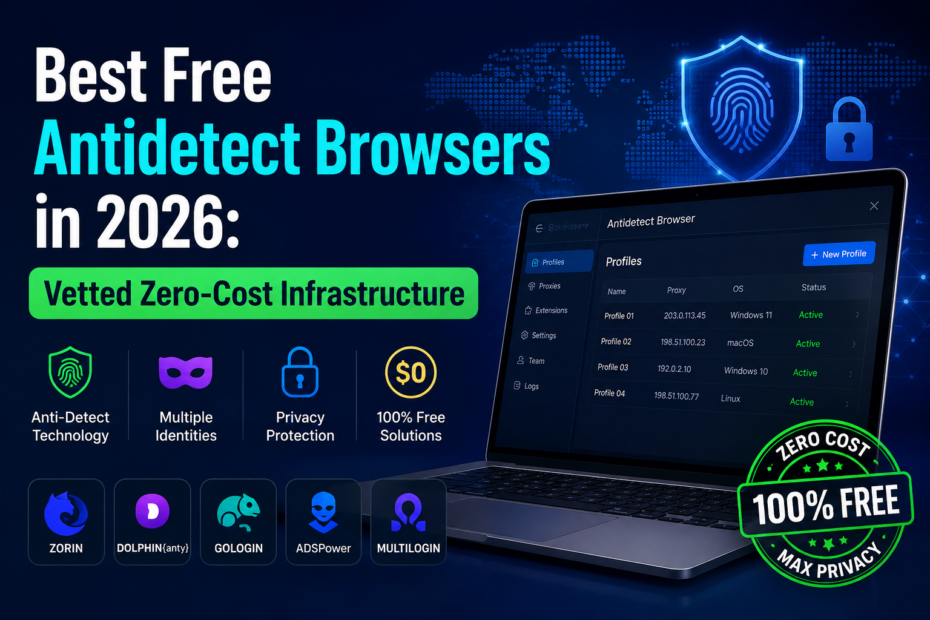
In the digital marketing landscape of 2026, efficient multi-accounting infrastructure remains a strict requirement for affiliate arbitrage, social media management, and global e-commerce. For solo operators, media buyers running pilot campaigns, and bootstrapped digital agencies, minimizing initial fixed software costs is a standard operational priority. This economic focus makes finding a dependable, free anti-detect tool highly essential. However, because modern anti-fraud systems utilize continuous machine learning and kernel-level fingerprint tracking, selecting a zero-cost workspace requires navigating strict structural trade-offs.
Most reputable software companies utilize a freemium monetization strategy. They give you access to their production-grade browser masking technology but place hard limits on profile capacity, automation capability, or team workspace features. Before moving your active profiles and digital assets into a cost-free workflow, it is crucial to analyze the market options. Reviewing the technical restrictions of the best free anti detect browser 2026 solutions will help you maintain high trust parameters without burning through your starting capital.
The Freemium Model: What Do You Actually Give Up for Free?
Maintaining a dedicated anti-detect browser requires continuous engineering updates to match public Chromium core releases and maintain an updated fingerprint database. Because of these infrastructure costs, completely unlimited free tools do not exist without significant security compromises (such as cookie logging or data scraping). Instead, reliable providers scale back specific features on their free tiers:
- Rigid Profile Ceilings: The industry standard is to restrict free accounts to a permanent allocation of 2 to 10 active profiles. Going beyond this limit requires an immediate transition to a monthly subscription.
- API and Automation Lockouts: Advanced capabilities like local REST API access, Puppeteer/Playwright integration, and no-code Robotic Process Automation (RPA) scripts are almost exclusively reserved for paid tiers.
- Time-Limited Usage Restrictions: Some platforms offer a higher number of initial free profiles (up to 10 or 20 instances) but cap the operational timeline to a 30-day or 60-day testing phase, after which your session data is locked behind a paywall.
Top Free Anti-Detect Browsers Vetted for Production Workloads
When selecting your budget infrastructure, platform reputation and engine reliability must always take priority over high profile quantities. The following tools represent the safest, most stable zero-cost options available on the market:
1. GoLogin (3 Profiles Forever)
GoLogin remains an industry standard for entry-level multi-accounting due to its custom Chromium fork, the Orbita engine. The permanent free tier includes 3 profiles and allows for 1 team member. GoLogin stands out by bundling free built-in datacenter proxies with their free plan. While these public proxy IPs are not suitable for bypass operations on highly secure platforms, they offer a perfect, cost-free sandbox for technical validation, web scraping, and basic account setups.
2. AdsPower (2 Permanent Profiles)
AdsPower is highly regarded within e-commerce and bulk advertising sectors due to its dual-engine architecture, providing both SunBrowser (Chromium-based) and FlowerBrowser (Firefox-based) instances. The free plan permanently permits 2 profiles. While the profile limit is strict, the free tier does not compromise on core fingerprint accuracy, allowing solo operators to safely run high-value storefronts or main advertising accounts with precise canvas, audio, and WebGL masking layers.
3. Dolphin{anty} (5 to 10 Profiles)
Deeply specialized for media buyers managing paid social traffic, Dolphin{anty} provides a highly functional free tier supporting 5 to 10 permanent profiles depending on active promotional periods. Its core advantage for budget setups is the inclusion of a native cookie robot. This utility automatically runs background sessions across top public web domains to accumulate cache files and history data, artificially building search profile trust prior to an official account login.
4. BitBrowser (10 Permanent Profiles)
BitBrowser represents one of the most generous entry-level tools on the market, offering 10 lifetime free profiles with standard fingerprint isolation characteristics. It features a straightforward user interface modeled directly on Google Chrome, lowering the operational friction for new managers. While its core engine update frequency can lag slightly behind premium enterprise competitors, it provides an exceptional, functional environment for social media growth and standard marketplace management.
The Hidden Risks of Low-Cost and Outdated Infrastructure
Relying exclusively on free browser software to run a scaling commercial operation introduces structural vulnerabilities that can negatively impact your business continuity.
The most severe vulnerability is **Chromium core update delays**. Anti-fraud algorithms cross-reference your user-agent string against the true structural capacities of the browser engine. If your free tier software lags three versions behind the official upstream Chromium releases while claiming to be modern, the architectural contradiction triggers an instant account ban. Additionally, cloud-synchronization servers are rarely prioritized for non-paying users, leading to potential data lag or session file corruption during peak operational hours.
Stepping Up to Next-Gen Security with Linken Sphere
For professional digital marketers who need to expand beyond the tight profile boundaries of basic free plans but want to bypass the bloated, expensive subscription rates of legacy anti-detect platforms, next-generation tools deliver a cleaner operational model. Linken Sphere bypasses traditional multi-accounting bottlenecks by shifting toward optimized resource allocation and localized session control.
Instead of forcing operators to constantly tweak manual fingerprint variables or manage unstable cloud sync connections that can break active account cookies, Linken Sphere automates the creation of flawless, structurally aligned digital identities. By managing memory overhead at the application level, it allows teams to run multiple independent profiles simultaneously without lagging local hardware. Whether you need an agile entry point or large-scale multi-accounting infrastructure, it offers a high-velocity solution engineered for modern web security protocols.
Operational Strategies for Managing Free Browser Profiles
If you choose to use free anti-detect browser tiers as part of your current operational stack, follow these strict technical protocols to protect your accounts from automated detection:
- Invest heavily in Proxy Quality: A free browser configuration matched with a cheap, blacklisted proxy will trigger an immediate suspension. Redirect your saved capital into high-quality residential or rotating mobile proxies, as network reputation carries immense weight in identity validation.
- Verify Fingerprint Consistency: Prior to authenticating your target accounts, run every profile through independent checking scripts like CreepJS, Iphey, and BrowserLeaks. Verify that the emulated hardware components, font arrays, and audio layers appear uniform and natural.
- Maintain Hard Copy Backups: Do not rely solely on the vendor’s free cloud infrastructure. Regularly export your active session cookies into standard JSON or Netscape text files. This allows you to immediately transfer your digital identities to alternative software if a platform changes its freemium terms.
Conclusion
Free antidetect browsers in 2026 are highly effective tools for learning cookie management, testing automation frameworks, and launching small-scale online businesses without upfront capital. However, as your operations expand and generate steady revenue, the operational ceilings of free plans—such as limited profile volumes, manual workflows, and restricted API access—will eventually slow down your business growth. Use reputable free versions to establish your workflow, but prepare to transition to high-performance, production-grade architecture as soon as your active business demands absolute infrastructure stability.

Leave a Reply