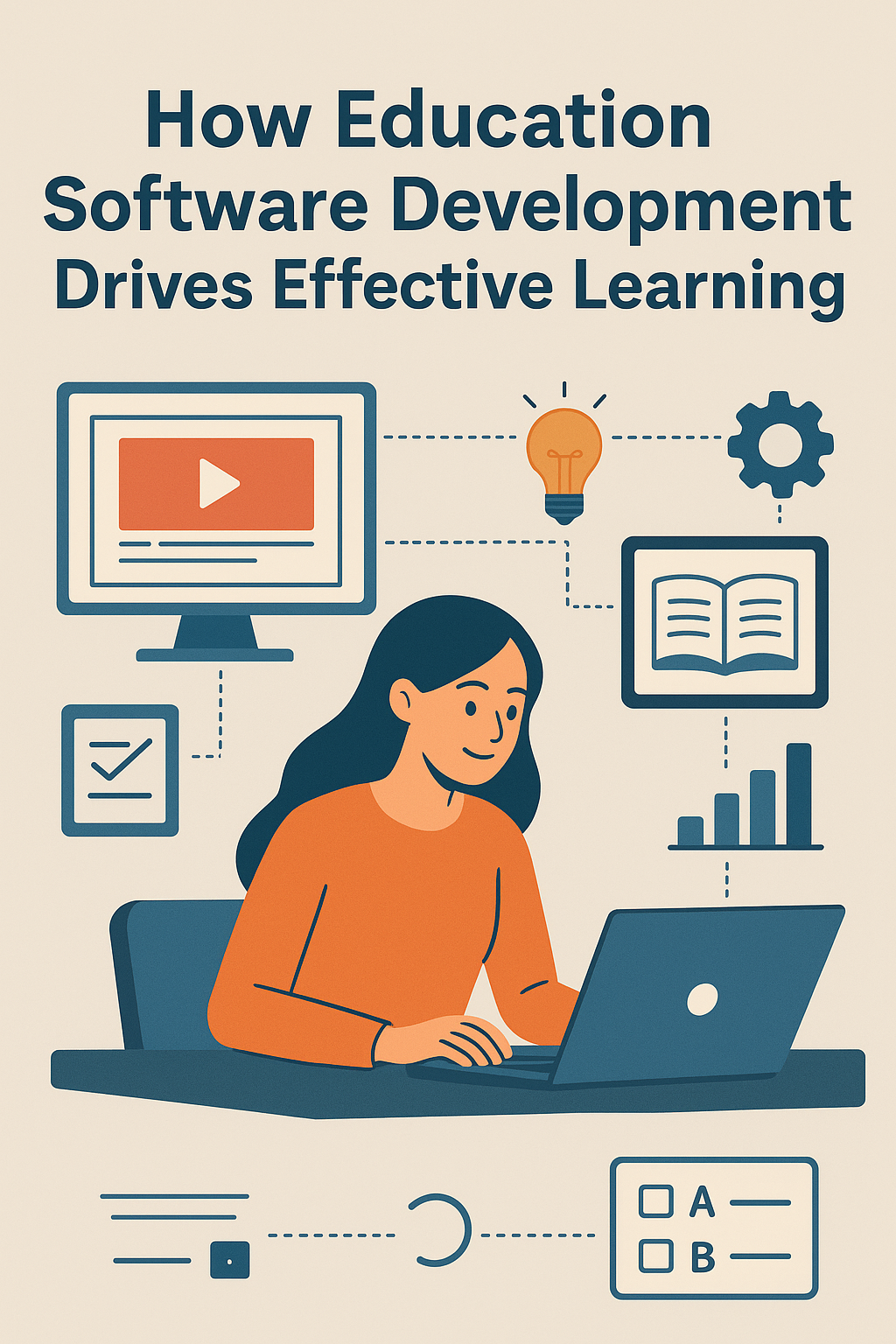
According to a report, the global education technology (EdTech) market size is estimated to reach USD 348.41 billion by 2030 at a 13.3% CAGR. Rapid technological advancements and broader access to high-speed internet have made EdTech tools more accessible than ever.
Many schools, universities, and corporate environments now develop custom education software to help learners learn better. This growing emphasis on lifelong learning and professional development makes next-gen learning programs more popular among adult learners and workplace training modules.
From Learning Management Systems (LMS) and online courses to interactive games and real-time performance tracking, EdTech solutions are redefining how learners engage, progress, and succeed. If you want to invest in education software development, read this blog. Gain insights into why modern educational infrastructure demands integration of new technologies.
EdTech software: What is it?
Education technology software consists of various digital platforms and tools that support academic administration, teaching, and learning. Through high-end applications, it facilitates skill assessments, interactive learning, and virtual collaboration.
It is a kind of digital learning software that is created by top-tier developers while considering pedagogical goals. The main objective of this solution is to provide easy access to quality education and boost learner engagement.
The modern EdTech industry develops a wide range of products, ranging from K-12 learning to corporate training materials and professional certification. Software development often comprises user experience (UX) design, cloud computing, big data, and artificial intelligence (AI) to deliver high-quality results.
Top features of EdTech software development
Modern EdTech software goes beyond digital textbooks and video lectures. It blends intuitive interfaces, AI-driven personalization, and cloud technology to create dynamic learning ecosystems.
Designed especially for students, teachers, and administrators, these platforms simplify management, enhance engagement, and deliver personalized education at scale. Below are the top features that make education software development effective and future-ready.
1. Intuitive and responsive user interface
A well-designed and user-friendly interface ensures smooth navigation for learners and educators. EdTech applications are increasingly designed to provide a consistent experience across mobile, tablet, and desktop, though performance and features may vary by device.
A responsive user interface (UI) makes learning accessible anytime and anywhere. It also improves retention rates by reducing barriers in the learning journey. – Source
2. Real-time data and learning analytics
Modern EdTech platforms are equipped with advanced analytics dashboards that track student performance, engagement, and learning patterns. These insights help educators pinpoint knowledge gaps, personalize lesson plans, and monitor progress.
Analytics provide insights into platform usage, resource allocation, and institutional performance. This is helpful for administrators to make informed decisions.
3. AI-powered personalized learning
Artificial intelligence is at the heart of personalization in education. AI algorithms analyze student behavior and adjust content according to their pace, style, and comprehension level.
Personalized quizzes, adaptive assessments, and intelligent recommendations are a few ways to create a tailored learning journey with e-learning solutions. However, for a successful AI integration, EdTech firms need to invest in the right custom offshore development services.
4. Cloud-based scalability and security
Cloud integration ensures smooth data synchronization across devices, secure storage, and real-time access to educational content. Many educational institutions benefit from scalability, since cloud platforms support thousands of users simultaneously without giving any performance issues.
Moreover, built-in encryption and backup systems enhance data protection, ensuring compliance with global security standards.
5. Engaging gamification features
Gamification has proven effective in boosting learner motivation. Features like points, badges, progress bars, and leaderboards make learning interactive and fun.
In K–12 education and skill-based training platforms, gamification encourages healthy competition and increases knowledge retention. It’s features turn lessons into experiences rather than tasks.
6. Multi-language and accessibility support
EdTech platforms often include multi-language support and accessibility features to reach diverse learners worldwide. They offer multilingual interfaces, screen-reader compatibility, and other tools for inclusivity.
These features are important for institutions that serve multicultural or geographically dispersed students. Overall, these platforms ensure that education remains accessible to all.
7. Comprehensive assessment and grading tools
Built-in assessment modules simplify how teachers create, administer, and evaluate tests. Activities like automated quizzes, essay evaluations, and instant grading systems save valuable time while maintaining transparency.
Students also benefit from immediate feedback, which helps them identify areas of improvement. Grading applications also provide educators with holistic performance data, which enhances accountability in academic evaluation.
8. Seamless third-party integrations
Integrating third-party tools, such as Learning Management Systems (LMS), video conferencing platforms, payment gateways, and digital libraries, makes EdTech software more versatile.
These integrations eliminate the need for switching between multiple apps. It helps companies streamline both teaching and administrative workflows through a unified ecosystem.
How does education software transform learning experiences?
The rise of education software has fundamentally changed the way students learn, teachers teach, and institutions operate. E-learning solutions creates a more engaging environment for global learners through digital accessibility, personalized learning, and automation.
Let’s discuss how custom software solution reshapes learning experiences.
-
Facilitating remote learning
EdTech delivers quality education beyond traditional classroom teachings. These applications help students attend live lectures, access recorded sessions and collaborate virtually with peers.
This flexibility has made education more accessible, particularly for those in remote areas or with limited mobility. It also allows institutions to reach a global audience.
-
Promoting inclusive education
Modern platforms incorporate features like screen readers, closed captions, and multi-language support. Including these elements in the platform ensures that even learners with disabilities or diverse cultural backgrounds can access education.
Education software is customized to address different learning needs. If you aren’t sure about tailored solutions, hire a developer who specializes in EdTech solutions.
-
Real-time feedback and improvements
EdTech empowers educators with tools to assess student performance instantly. Automated quizzes, AI-driven analytics, and adaptive assessments are effective in identifying areas where learners struggle.
Leveraging digital learning tools enables teachers to adjust lesson plans and provide them with the necessary academic support. Moreover, real-time feedback also benefits students, helping them identify and address weaknesses early.
-
Enhancing student engagement
Learning platforms now incorporate interactive modules, gamified content, and live quizzes to retain and engage learners. These features shift education from passive consumption to active participation.
These exciting features influence students to engage more deeply with their areas of educational interests, which leads to better learning outcomes and academic excellence.
-
Streamlining administrative tasks
Education software simplifies institutional processes beyond classrooms. Automated attendance tracking, digital grading, communication tools, and fee processing reduce manual effort. This not only improves efficiency but also allows teachers and administrators to dedicate more time to supporting students and improving curriculum quality.
-
Supporting lifelong learning
EdTech is not limited to schools and universities. Many professionals in reputable U.S. organizations also use online platforms for upskilling, reskilling, and continuous education.
With flexible schedules and on-demand courses, individuals can advance their careers without disrupting their work or personal commitments. Digital learning tools has made lifelong learning more practical and mainstream as well.
Emerging trends in EdTech software development
Education technology is evolving rapidly, with software development at the center of this transformation. As institutions seek innovative ways to deliver engaging and effective learning experiences, several trends are shaping the future of EdTech software development in the U.S.
From artificial intelligence to blockchain, these advancements are redefining how students learn, how teachers teach, and how educational outcomes are measured.
-
AI-driven tutoring systems
Artificial intelligence is an important aspect of personalized education. Moreover, AI-powered tutors are always-available learning assistants, which answers student queries, breaks down complex concepts, and offers tailored guidance.
Digital learning systems adapt to pace and preferences of every learner individually, providing customized recommendations. This trend not only improves academic support but also reduces dependency on one-to-one human tutoring, making education more accessible.
-
Virtual and augmented reality learning
Immersive learning environments using virtual reality (VR) and augmented reality (AR) are gaining recognition in EdTech development. These tools allow students to step inside historical landmarks, conduct simulated scientific experiments, or practice technical skills in lifelike environments.
The interactive nature of VR/AR enhances engagement and improves knowledge retention. This trend promises to bridge the gap between theoretical learning and real-world application for skill-based and professional training.
-
Blockchain for academic credentialing
Blockchain technology is transforming how academic records are managed. It enhances transparency in student achievements by enabling tamper-resistant and verifiable credentials. This reduces fraud, speeds up verification for employers and universities, and gives learners lifelong ownership of their academic data.
As more institutions adopt blockchain, credential validation is expected to become more secure and widely accepted.
-
Rise of microlearning platforms
Amidst busy schedules, microlearning is emerging as a dominant format in the education business. These platforms deliver content in bite-sized lessons, making learning flexible and efficient.
Professionals in particular benefit from just-in-time training modules, allowing them to quickly acquire or refresh specific skills without committing to long courses. Microlearning’s adaptability makes it a strong fit for mobile-first education strategies.
-
API-first platform development
Modern EdTech solutions increasingly adopt API-first approach. This design philosophy ensures successful integration with third-party systems like learning management systems (LMS) and customer relationship management (CRM) tools.
API-first architectures enhance flexibility, enabling institutions to customize ecosystems according to their specific needs. This trend has helped EdTech platforms to emerge as scalable and future-proof solutions. To accelerate such innovation, many institutions leverage IT staff augmentation services for acquiring talent who are proficient in API architectures.
Conclusion
EdTech software development is consistently evolving with the integration of AI, cloud computing, and user-centered design innovations. Features like personalized learning, gamification, and analytics ensure transformation of teaching and learning platforms.
With accessibility, scalability, and engagement, modern EdTech software is paving the way for a more connected, inclusive, and effective learning environment. However, hiring an offshore developer for your EdTech innovation can save your expenses over full-time hires. Try exploring your options with a global outsourcing partner to get the best workforce for education software development in the U.S.
